

What would it cost to break it?
Get a rough prepayment penalty for breaking your mortgage early, using the two common methods. Then see whether a lower rate would cover it over the time left in your term.
Rough numbers only. This is a calculator for planning, not an approval or advice. Rates shown are examples you can change. Nothing you type is saved unless you choose to email it to yourself.
- Three months' interest
- Interest rate differential (IRD)
- Method that applies
- Balance the penalty is based on
- Interest saved at the new rate, rest of term
- Net after the penalty
Rough numbers for planning only. This isn't an approval, a quote, an offer or advice. Example rates are for the math and aren't rates we're offering. Your lender's policies, your credit and the property change the real answer.
Three steps.
Pick fixed or variable
Variable mortgages usually charge three months' interest. Fixed mortgages usually charge the greater of three months' interest or the interest rate differential.
Enter your balance and time left
Your latest statement has both. If you can prepay part of the balance first, add your prepayment privilege.
Add the comparison rate
Lenders compare your rate to their rate for a term close to what you have left. If you got a discount off a posted rate when you signed, add it. Big banks often use that method.
Worth knowing.
Two methods, one penalty
Three months' interest is simple: about a quarter of a year's interest on your balance. The interest rate differential, or IRD, is the gap between your rate and the lender's comparison rate, applied to your balance for the time left.
Why bank penalties surprise people
Some lenders calculate the IRD using posted rates minus the discount you got when you signed. That can make the gap much bigger than you'd expect. Your mortgage contract spells out the method.
Always ask for the real number
Your lender has to give you the actual penalty, and it can change daily with their rates. Use this tool to know if the number you're quoted is in the right range.
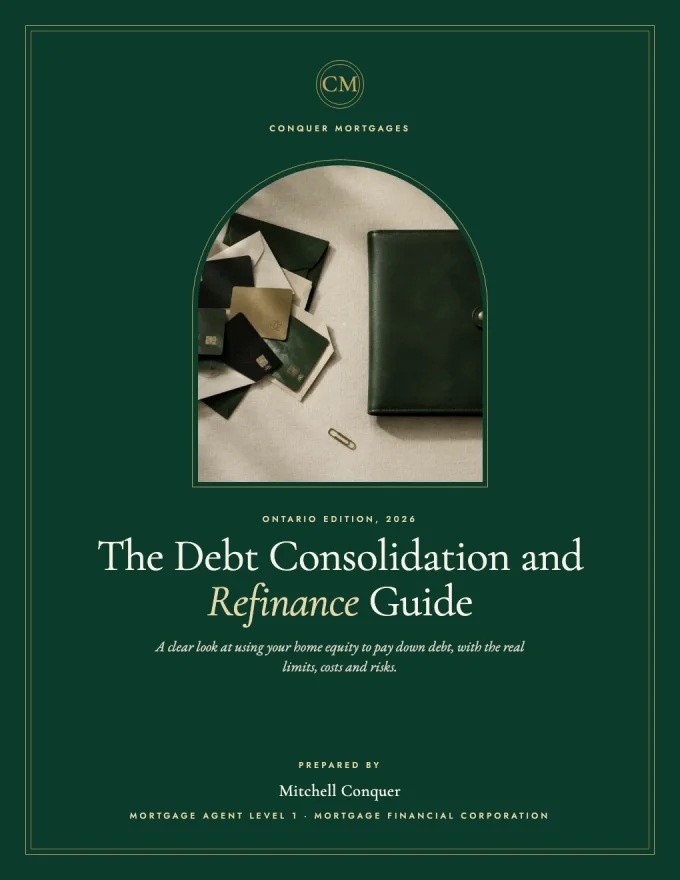
The Debt Consolidation and Refinance Guide
How refinances, HELOCs and second mortgages work, what breaking costs and when it makes sense.
Get the free guideHow is a mortgage penalty calculated in Canada?
For most fixed-rate mortgages, it's the greater of three months' interest or the interest rate differential (IRD). For most variable-rate mortgages, it's three months' interest. Your contract sets the exact method, so always confirm the number with your lender.
What is the interest rate differential (IRD)?
It's the difference between your mortgage rate and the rate your lender uses for comparison, usually its rate for a term close to the time you have left, applied to your balance for that remaining time. Some lenders use posted rates minus your original discount, which can raise it.
Can I lower my mortgage penalty?
Sometimes. Using your yearly prepayment privilege first can shrink the balance the penalty is based on. Porting or blending your mortgage with the same lender can avoid it. Breaking closer to maturity also usually lowers it.
When is breaking my mortgage worth it?
When the interest you'd save at the new rate over the rest of your term clearly beats the penalty and any costs to switch. The break-even section of this tool gives you a first look.
Want the real number?
These are rough numbers. I can run your actual file against real lender criteria, and checking your options won't touch your credit.
Keep running the numbers
Renewal decision
Stay, switch or reset your amortization. Compare the real cost over your term, side by side.
Open the tool Debt consolidation analyzerDebt consolidation
Roll cards and loans into your mortgage. See the monthly savings and the honest long-term cost.
Open the tool Home equity checkHome equity check
How much of your equity you could access with a refinance or a HELOC, and what it could cost monthly.
Open the tool