

What would one payment really save?
List your debts and your mortgage. You'll see what you'd free up each month, what stretching that debt over 25 years costs, and how fast you'd be done if you kept paying what you pay today.
Rough numbers only. This is a calculator for planning, not an approval or advice. Rates shown are examples you can change. Nothing you type is saved unless you choose to email it to yourself.
| Today | Consolidate | Consolidate + keep paying | |
|---|---|---|---|
| Monthly payments | |||
| Debt-free in | |||
| Total interest |
- Debt rolled in
- New mortgage
- New loan-to-value
Rough numbers for planning only. This isn't an approval, a quote, an offer or advice. Example rates are for the math and aren't rates we're offering. Your lender's policies, your credit and the property change the real answer.
Three steps.
List every debt
Balance, interest rate and the monthly payment you actually make. Add rows for each card, loan or line of credit.
Add your home and mortgage
Your rough home value, what you owe, your current rate and how many years are left.
Read all three outcomes
Today's path, the stretched-out consolidation, and consolidating while you keep paying today's total. The third one is where the real savings live.
Worth knowing.
The 80% line
A regular refinance tops out at 80% of your home's value, including what you already owe. If your total goes past that, a second mortgage or an alternative lender may still work, usually at a higher cost.
Monthly relief can hide a long tail
Moving a five-year car loan into a 25-year mortgage lowers the payment and can raise the total interest on that debt. The calculator shows both so you can decide with your eyes open.
The move that pays off
If you consolidate and keep sending what you pay today, the extra goes straight at the principal. That's how people clear the debt and shave years off the mortgage at the same time.
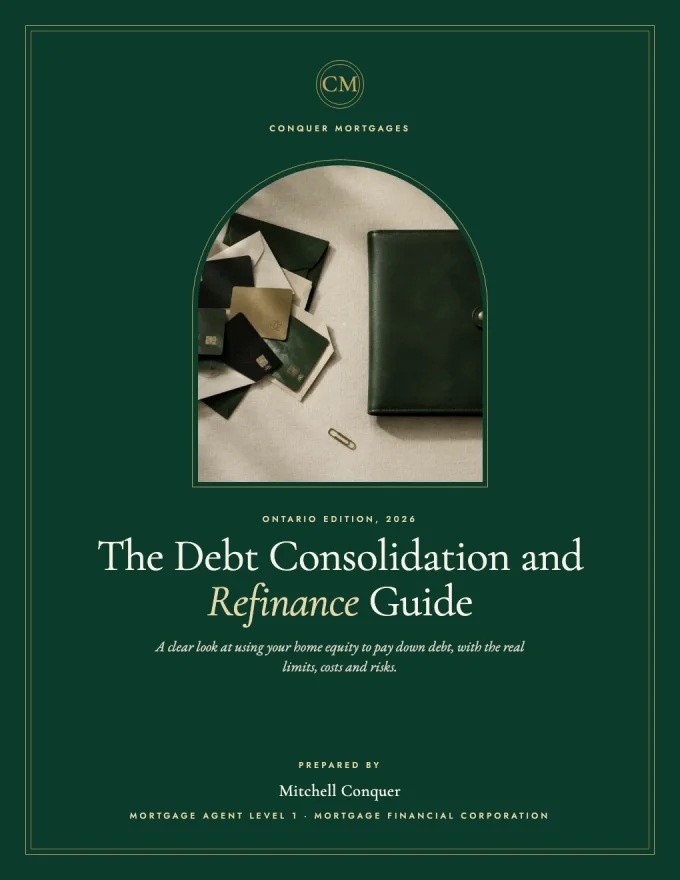
The Debt Consolidation and Refinance Guide
How refinances, HELOCs and second mortgages work, what breaking costs and when it makes sense.
Get the free guideGood questions.
How much equity do I need to consolidate debt into my mortgage?
For a regular refinance, your new mortgage including the debts generally can't go past 80% of your home's value. So you need enough equity above 20% to cover the debts and any penalty. This calculator shows your new loan-to-value as you go.
Will consolidating debt into my mortgage cost more in the long run?
It can. A lower rate helps, but spreading short-term debt over 25 years can add interest. If you keep paying close to what you pay today, you usually come out well ahead. The calculator shows all three paths.
Is there a penalty to refinance before my term ends?
Usually, yes. Fixed mortgages often charge the greater of three months' interest or an interest rate differential, and variable mortgages usually charge three months' interest. Use the penalty calculator for a rough number and add it here.
Does consolidating hurt my credit?
Paying off cards can lower your credit utilization, which often helps over time. The refinance itself involves a credit check. The bigger risk is running the cards back up, so have a plan for them.
Want the real number?
These are rough numbers. I can run your actual file against real lender criteria, and checking your options won't touch your credit.
Keep running the numbers
Home equity check
How much of your equity you could access with a refinance or a HELOC, and what it could cost monthly.
Open the tool Mortgage penalty estimatorPenalty estimator
Rough prepayment penalty for breaking a fixed or variable mortgage, and whether breaking pays.
Open the tool Renewal decision toolRenewal decision
Stay, switch or reset your amortization. Compare the real cost over your term, side by side.
Open the tool